
Texas Job Market Grows by More Than 177,000 Positions Over the Year

July 20, 2026

Texas added 43,400 nonfarm jobs in June to reach a total of 14,469,600 positions. Over the year, the state added 177,900 jobs for an annual growth rate of 1.2 percent, outpacing the national growth rate by 0.9 percentage points.

Texas’ civilian labor force registered at 15,904,900 after adding 3,400 people over the month. Over the year, Texas’ civilian labor force has added 29,700 people.

The seasonally adjusted unemployment rate in Texas registered at 4.4 percent.

“Texas’ continued job growth is a testament to the strength of our employers and robust workforce development system,” said TWC Chairman Joe Esparza. “The addition of more than 177,000 jobs over the year reinforces Texas’ reputation among employers as the best place to start and grow a business.”

The Professional and Business Services industry had the largest private sector over-the-month increase in June after adding 25,500 jobs. Leisure and Hospitality added 10,300 jobs over the month while Trade, Transportation, and Utilities added 6,400.

“The growth of the Texas labor market highlights the incredible talent and dedication of our state’s workforce,” said TWC Commissioner Representing Labor Alberto Treviño III. “The Texas Workforce Commission is committed to ensuring every Texan has the support they need to thrive, whether through training opportunities to gain new skills or specialized programs that help our foster youth transition into successful careers.”

The Midland metropolitan statistical area (MSA) had the lowest unemployment rate with a not seasonally adjusted rate of 3.6 percent in June. It was followed by the San Angelo MSA at 3.9 percent and the Abilene MSA at 4.0 percent.

“With an annual growth rate of 1.2 percent, Texas continues to outpace the national average and demonstrate economic resilience,” said TWC Commissioner Representing the Public Brent Connett. “Both job seekers and employers can seek customized career services and recruitment assistance by visiting our TWC website or their local Workforce Solutions office.”

Employment estimates released by TWC are produced in cooperation with the U.S. Department of Labor’s Bureau of Labor Statistics.
*All estimates are subject to revision. To access this and more employment data, visit TexasLMI.com.

The Texas Labor Market Information Data for July is scheduled to be released on Friday, August 21, 2026, at 9:00 a.m. (CT).
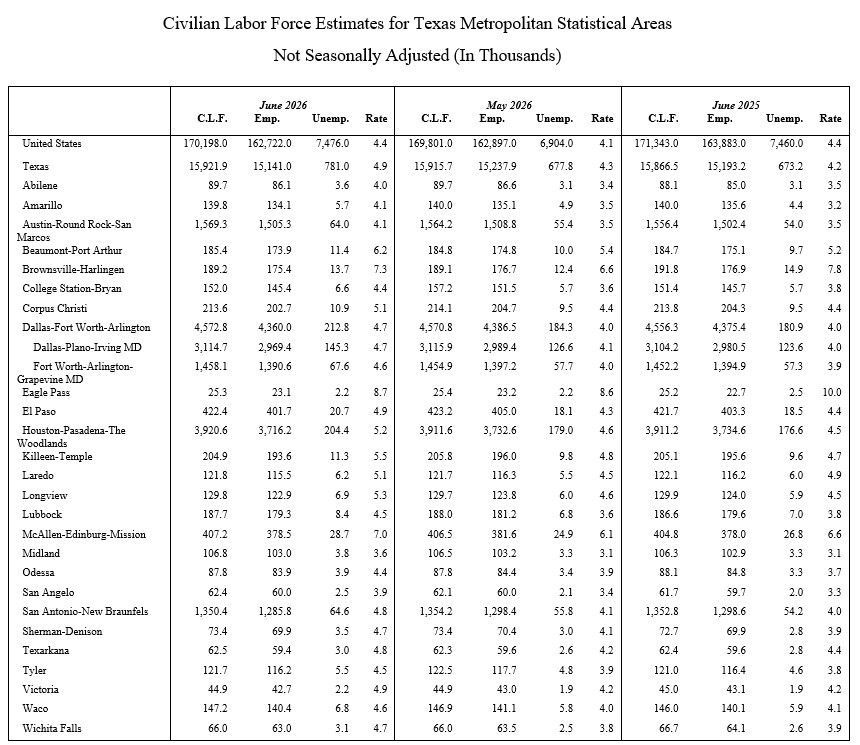
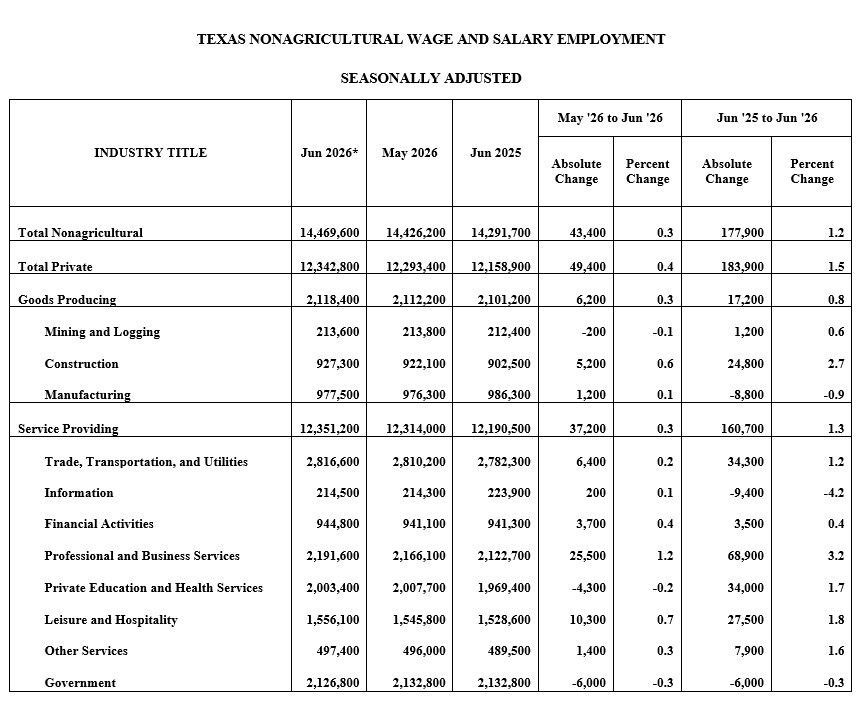
Table showing civilian labor force estimates for the Texas metropolitan area by not seasonally adjusted data.
Black-and-white table titled “Texas nonagricultural wage and salary employment” with monthly employment figures.
July 20, 2026
Workforce Solutions East Texas Child Care Services is proud to partner with the Panola County Chamber of Commerce to support child care leaders across the region. Through this partnership, the Chamber provides a welcoming meeting space for Directors Connect training designed to help early learning program owners and directors connect, learn, and grow together. The partnership was made possible through the support of Keri Perot-Vance, Executive Director of the Panola County Chamber of Commerce, whose commitment to community collaboration helped create a space where child care leaders can come together to share ideas, discuss challenges, and strengthen their leadership skills. The partnership began in 2025 in response to daycare owners expressing a need for accessible training opportunities. Recognizing this need, Panola County Chamber of Commerce graciously offered to host the Directors Connect training in its beautiful historic building. This collaboration provides child care professionals with the opportunity to earn professional development hours required to remain in compliance with Child Care Regulation and Texas Rising Star. Tonia Crawford and Aerial Jones, Business Industry Specialists for Child Care Services and facilitators of Directors Connect, say the program has evolved into so much more than a training opportunity. It has become a space for meaningful conversations, professional connections, and shared solutions. Through these gatherings, directors are strengthening their businesses, growing as leaders, and ultimately enhancing the quality of care provided to children and families throughout East Texas. Workforce Solutions East Texas Child Care Services is grateful for the Panola County Chamber of Commerce's ongoing support and looks forward to continuing this impactful partnership for years to come. Together, we are investing in stronger leaders, stronger child care programs, and stronger communities.
By Workforce Solutions East Texas July 13, 2026
Workforce Solutions East Texas welcomed an excellent crowd on July 8, 2026, for a ribbon cutting celebrating its new Tyler Workforce Center in Midtown Centre. The event marked an important milestone for the organization and highlighted its continued commitment to expanding access to workforce services in one of East Texas’s key communities. Workforce Solutions East Texas provides no-cost services for employers and job seekers and is part of the broader Texas Workforce Solutions network overseen by the Texas Workforce Commission. Guests heard remarks from Congressman Nathaniel Moran, Workforce Solutions East Texas Board Chair Gene Keenon, Chief Elected Officials Board Chair Marion County Judge Leward LaFleur, ETCOG Executive Committee 2nd Vice Chairman and Smith County Commissioner Ralph Carraway Sr., and ETCOG Executive Committee Chairman and Whitehouse Mayor James Wansley. Located at 1421 S. Beckham Avenue, the new center strengthens Workforce Solutions East Texas’s presence in Tyler and offers a larger, more connected space for service delivery. The 28,500-square-foot facility brings departments together under one roof and was designed to support employers, job seekers, and community partners with convenient access and room for future growth. The new center reflects the organization’s mission of connecting East Texans to opportunity while helping businesses recruit, hire, train, and retain skilled workers. Through local partnerships and support from the Texas workforce system, Workforce Solutions East Texas continues working to strengthen the regional economy and create pathways to long-term success for East Texas families and communities.
June 24, 2026
Each July, Disability Pride Month is celebrated as a time to recognize the history, achievements, experiences, and contributions of people with disabilities. The observance traces back to July 26, 1990, when the Americans with Disabilities Act (ADA) was signed into law, marking a major milestone in disability rights. The first official Disability Pride Month was later recognized in July 2015 during the 25th anniversary of the ADA. Disability Pride Month is not only a celebration but also a reminder of the importance of visibility, accessibility, and inclusion. It highlights the disability community’s ongoing advocacy and the progress made through legislation, public awareness, and collective action. One of the most recognized symbols of Disability Pride is the Disability Pride flag. In 2019, writer Ann Magill, who has cerebral palsy, created the original flag after a negative experience at an ADA anniversary event. The first design featured bright zigzagging stripes over a black background, meant to symbolize the barriers people with disabilities face. However, members of the disability community shared that the design could trigger symptoms for some individuals with visually sensitive disabilities when viewed on screens. In response to that feedback, Magill revised the design by straightening the stripes, muting the colors, and adjusting the arrangement to better accommodate red-green colorblindness. The updated flag reflects the community’s commitment to accessibility and collaboration, showing how people can work together to meet differing access needs. Magill also placed the design in the public domain, making it available for all to use and adapt. Each color in the Disability Pride flag carries meaning: Red represents physical disabilities Gold represents neurodiversity White represents invisible disabilities and undiagnosed conditions Blue represents emotional and psychiatric disabilities Green represents sensory disabilities, including deafness and blindness Faded Black background represents mourning and rage for victims of ableist violence and abuse Disability Pride Month also offers an opportunity to reflect on the history of disability rights legislation in the United States. Over the last century, important laws have helped expand services, protect civil rights, and improve access to employment and public life. Milestones include the Smith-Fess Act of 1920, the Social Security Act, the Vocational Rehabilitation Act Amendments, the Rehabilitation Act of 1973, the ADA, the Rehabilitation Act Amendments of 1992, and the Workforce Innovation and Opportunity Act (WIOA). Together, these laws helped shape a stronger framework for inclusion, employment support, nondiscrimination, and access to services for people with disabilities. They also reflect the work of advocates, policymakers, and communities who pushed for a more equitable society. During Disability Pride Month, we recognize both progress made and the work that continues. It is a time to celebrate identity, honor disability history, and reaffirm the importance of creating communities and workplaces where everyone has the opportunity to participate fully.
Show More