Workforce Solutions East Texas Precautions and Service Changes in Response to COVID-19
Workforce Solutions East Texas • March 18, 2020

Event Cancellations, Center Closures to the Public, and Service Availability to Individuals with Employment Impacts
As emergency declarations have been made at the National, State, and with multiple counties in our area due to the Coronavirus (COVID-19), the Workforce Solutions East Texas (WSET) team has mobilized to ensure the health and safety of customers and staff, while ensuring that our business services, early childhood development programs and workforce services, will continue throughout our East Texas region.
Dr. Robert Haberle, Chairman of the Workforce Solutions East Texas Board, said, “Our hearts are with our communities. Our critical businesses depend upon a skilled and healthy workforce to bring their products to market and an equally healthy customer base to buy those products. WSET will continue to serve our employers by helping workers and those wanting to work in every way possible. We will safeguard the Centers, limit exposure for participants and staff, and still find ways to keep our friends and neighbors in jobs that allow them to bring home a paycheck. We’re here to serve, in the most effective ways possible.”
The WSET team is committed to meeting the needs of job seekers and employers in our fourteen-county region, and we want to ensure that the health and safety of our customers and staff are taken into consideration in these difficult times. To combat the spread of COVID-19, effective at 8:00 AM, Thursday, March 19th, our workforce centers will close to the public. Although we are not allowing visitors, we will continue to serve WSET customers. At this time, we anticipate the centers will remain closed through May 1st. We invite all job seekers, to continue job search with www.WorkInTexas.com, and to contact our career advisers at 1-844-ETWORKS (844-389-6757)
for individual assistance. Staff will be making online service applications, required program orientations, and virtual events available on our website, in the near future.
If you are a worker whose employment has been disrupted by economic changes caused by COVID-19 concerns, we can assist you in finding new work or training for a higher-skilled role in related industries. WSET provides an array of services and programs that are designed with career development at every stage of your workforce journey, including up-skilling opportunities with local training providers. We can also provide information on unemployment benefits from the Texas Workforce Commission. Please contact TWC’s Unemployment Benefits hotline at 800-939-6631
if your employment has been impacted by COVID-19.
For our business community, WSET can assist with customized proactive outplacement services or layoff aversion strategies at no cost. Rapid Response services provide early business-focused intervention assistance designed to transition affected workers to their next employment. Our services are tailored to each company, based on the needs of the affected employees. Please call our Business Services team at 1-844-ETWORKS (844-389-6757), or email employerservices@easttexasworkforce.org, for more information on Rapid Response services for employers.
For families taking part in our child care and early childhood learning programs throughout the East Texas area, we are working with our child care services providers to ensure a continuum of care for currently enrolled children, as events arise that may lead to a temporary change in a parent’s work, education, or training status. If you have questions, please contact our WSET Child Care Services team for assistance at easttexas.ccs.customers@gmail.com
or 1-800-676-8283.
The U.S. Department of Labor has published the "Guidance on Preparing Workplaces for COVID-19" to help reduce the impact of Coronavirus. The guide also provides information to help employers and workers regarding issues they may face, including effects on wages and hours worked under the Fair Labor Standards Act (FLSA) and job-protected leave under the Family and Medical Leave Act (FMLA). Access that guide at: https://www.dol.gov/newsroom/releases/osha/osha20200309
We have to prepare ourselves for the days ahead and we have taken precautions to maintain the safety and security of our employees and customers as best we can,” said WSET Centers Director, Mary Ann Rojas. “We are so fortunate to have the infrastructure in place to continue to serve our constituents which are located throughout a 14-county region. We will mobilize our call center to assist those needing direct personal assistance. We will have virtual workshops and our Career Edge platform to walk you through any process whether it is helping you with a resume, applying for training assistance or referring to the appropriate services. We are ramping up to have specialists assigned to assist those being laid off and we will continue to work with our employers to find better ways to connect with the job seeker. Meanwhile we will continue to assess the situation daily.”
WSET will continue to monitor the COVID-19 situation and share important updates and resources on our website at www.easttexasworkforce.org/COVID-19, and through our social media networks. For more information, contact WSET Centers Director, Mary Ann Rojas at (903) 561.8131.

Workforce Solutions East Texas is seeking employer partners for Hiring Red, White & You!, the local celebration of Texas’ statewide veterans hiring event. Join us on Tuesday, November 10, 2026, at the Tyler Workforce Center, 1421 S. Beckham Ave., Tyler. The opening ceremony begins at 9:30 a.m., followed by the hiring event from 10 a.m. to 1 p.m. Hiring Red, White & You! connects employers with veterans, transitioning service members, military spouses, and other qualified East Texas job seekers. It is an opportunity to meet candidates whose military experience often reflects leadership, adaptability, communication skills, and a strong commitment to service. This event is open to the public, making it an excellent opportunity to promote current openings and build your organization’s talent pipeline. Employer participation is available at no cost. Across Texas, Hiring Red, White & You! events have connected more than 26,000 employers with 153,000 job seekers, including more than 52,000 veterans. Employers who hire qualifying veterans may also be eligible for federal Work Opportunity Tax Credit benefits of up to $9,600 per eligible hire. Reserve your employer space today by registering at www.EastTexasWorkforce.org/hrwy .

The Texas Workforce Commission (TWC) is currently accepting applications for the Upskill Texas grant program. This technical training initiative provides crucial funding for Texas businesses looking to enhance their workforce's skills and remain competitive in today's rapidly evolving economy. Upskill Texas offers financial support to employers that are: Expanding their operations Retooling their processes Introducing new services or product lines Experiencing organizational structure changes that could avert layoffs Through Upskill Texas, employers may be reimbursed up to $3,000 per trainee for 100% technical training. The majority of the trainees must have been employed by the business for at least six months. To be eligible, businesses must have 100 or more employees located in Texas and provide a 50% employer match, which can include trainee wages and benefits. Private employers may appoint a designee for the grant, including community or technical colleges, third-party trainers, or workforce development boards. Projects can range from $150,000 to $500,000. Follow the link below to learn more.
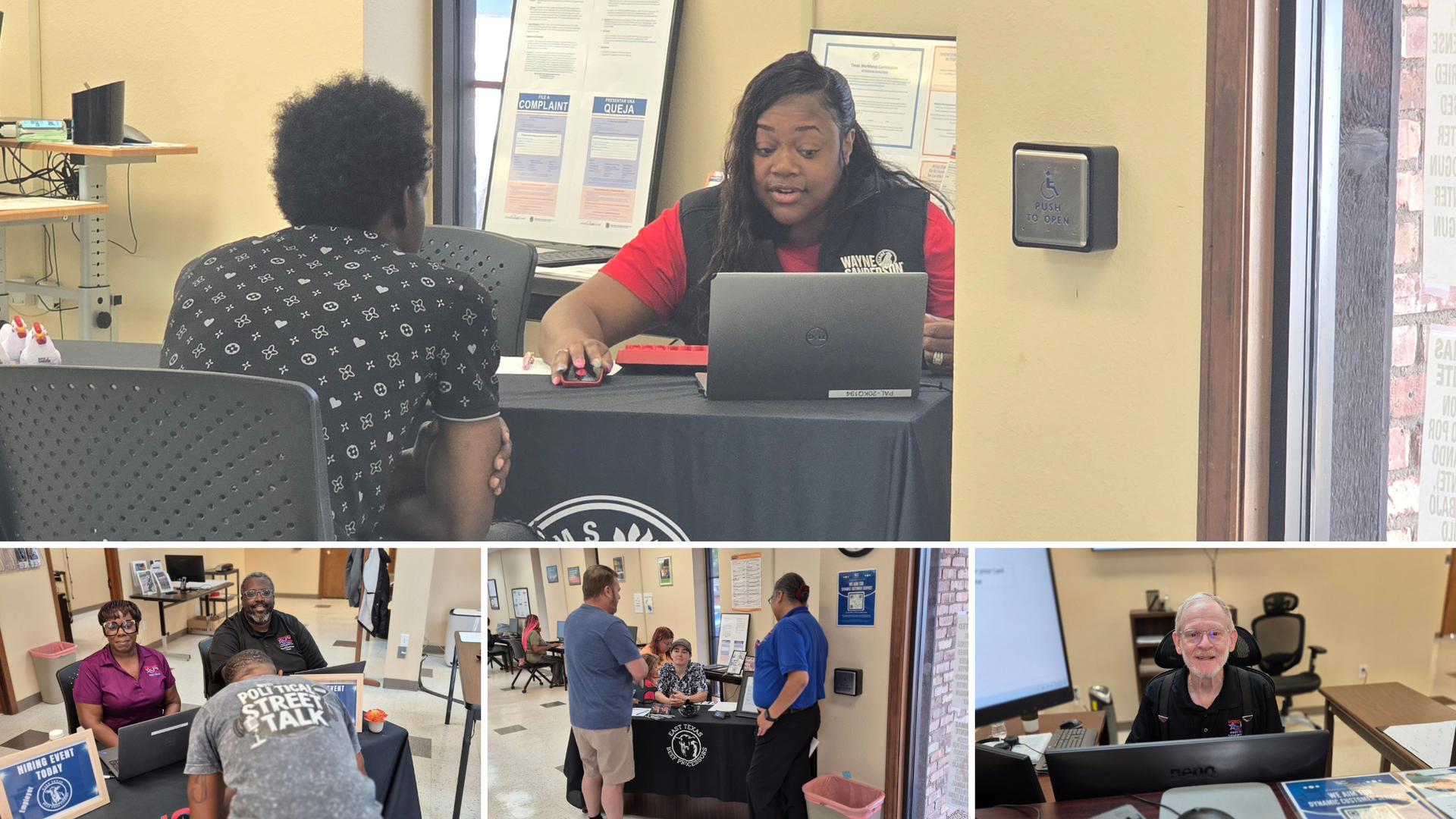
Workforce Solutions East Texas is strengthening its role as a workforce development leader in the Palestine area by bringing some of the region’s top employers directly to the community. Through a growing series of hiring events hosted at the Palestine office, local job seekers are gaining direct access to employers, career opportunities, and a dedicated team ready to help them take their next step. The events have already generated strong results. On August 14, Wayne Sanderson Farms brought 51 job seekers to the Palestine office for a hiring event. The response was so strong that the company was able to fill its entire first shift through the event, demonstrating the impact that direct connections between employers and job seekers can have. The momentum continued on September 4, when East Texas Beef Processors welcomed 50 job seekers to its hiring event at the Palestine office. The strong turnout provided the company with an opportunity to connect with local talent while giving residents a chance to learn more about available careers and employment opportunities. These events are doing more than filling positions. They are helping Workforce Solutions East Texas build stronger relationships with employers throughout the region while establishing the Palestine office as a convenient, trusted resource for businesses and job seekers alike. By creating opportunities for employers to recruit locally, Workforce Solutions East Texas is helping strengthen the connection between the region’s workforce and the businesses that drive its economy. Residents looking for their next career opportunity are encouraged to stop by the Palestine Workforce Solutions East Texas office, meet with employers, explore available positions, and connect with the staff who are ready to provide guidance and support throughout their job search. As the Palestine office continues expanding its employer partnerships and hiring event offerings, Workforce Solutions East Texas is demonstrating what workforce development looks like in action: bringing employers and job seekers together, responding to the needs of the local economy, and creating pathways to opportunity right here in the community.