
TWC Reinstates Unemployment Insurance (UI) Work Search Requirement
Texas Workforce Commission • October 13, 2020

AUSTIN – The Texas Workforce Commission (TWC) announced today that as the Texas economy continues to open, TWC will reinstate work search requirements, which has been suspended since March, but will resume on November 1, 2020. Work search is a federal requirement to receive unemployment benefits. Individuals will continue to receive benefits but must show an active effort to obtain new employment.
All individuals receiving unemployment benefits will need to complete a designated number of work searches, beginning on the date listed on their work search notification document. The work search notification document can be found in their correspondence inbox at ui.texasworkforce.org
or U.S. Postal Mailbox. For example, individuals with an initial or additional claim the week of November 1st – work search activities would be effective the week beginning November 8th. For individuals with existing claims requesting payment the week of November 1st, work search activities would be effective the week beginning November 15. TWC encourages all claimants to refer to their work search notification document.
“The COVID-19 crisis has been difficult for everyone, creating new challenges for workers, employers, and their families,” said TWC Executive Director Ed Serna. “Let me be clear, we are not over it, but we’re seeing employment opportunities begin to bounce back in Texas as our economy restarts. There are opportunities out there, and getting Texans back to work and businesses up and running again will create even more.”
There are approximately over 695,000 jobs available in Texas on WorkInTexas.com, the state’s online jobs portal, in addition to jobs available elsewhere.
Unemployment insurance benefits are not intended as a replacement for a job, but a temporary benefit to help workers resume employment. The work search requirement does not mean workers must take the first job available. It means that they must show an active effort to obtain new employment to continue benefits. As long as they do this, their benefits will continue for as long as they are eligible.
Furloughed workers with a definite return to work date 12 weeks of the layoff are exempt from work search requirements. Return to work dates beyond 12 weeks can result in the waiver of work search at the discretion of TWC. While self-employed individuals who intend to reopen their business do not need to complete work search activities. They do need to take steps to reopen their business. Self-employed individuals who do not intend to reopen their business will need to complete work search activities.
TWC has determined that acceptable work search activities include, but are not limited to:
- Registering on WorkInTexas.com. For help with the registration process, go to WorkInTexas.com, scroll down to the “News and Announcements” section, and select “Registration Resources and Website Usage Tips.” For support, contact your local Workforce Solutions Office
- Searching for jobs on WorkInTexas.com and using the Virtual Recruiter tool to receive alerts about new jobs that match your skills.
- Obtaining and following up on job contacts from WorkInTexas.com or Workforce Solutions office staff.
- Registering at a public workforce office in the state you live in if you do not live or work in Texas.
- Registering for work with a private employment agency, placement service of a school/college/university, or registering with other electronic job-matching systems (does not replace WorkInTexas.com registration).
- Making in-person visits, completing a job application, or interviewing with employers who may reasonably be expected to have openings for suitable work. The job application can be submitted in person, online, by fax, or in any other manner directed by the employer and appropriate for the type of work being sought.
- Mailing a job application and/or a résumé as instructed by a public job notice.
- Creating a reemployment plan.
- Creating or uploading a résumé to online job boards.
- Participating in work-related networking events such as job clubs or job fairs, or employment-related workshops that offer instruction in improving the job seeker’s skills for obtaining employment.
- Taking advantage of reemployment services and resources available at your nearest Workforce Solutions office virtually. For more details, contact your local Workforce Solutions office. Reemployment resources include:
- Obtaining and using labor market information.
- Participating in reemployment services designed for job seekers.
- Participating in skills assessments for occupational matching.
- Participating in instructional workshops, such as résumé preparation and enhancement, job-search techniques, and interviewing skills.
- A Metrix course that is completed with a passing score can be one of your work search activities.
- Participating in targeted training opportunities designed to improve skills.
What resources are available to help individuals search for work?
TWC has over 180 workforce solutions offices around the state ready to assist claimants with everything from resume writing to job searching. TWC has partnered with Metrix Learning to offer over 5,000 online courses free to all Texans. These courses count as work search activities. Individuals wishing to sign up can do so through their WorkinTexas.com
account. Additionally, Job seekers are encouraged to visit WorkInTexas.com, the state’s job portal, for access to hundreds of thousands of public and private sector jobs, as well as links to education and training opportunities, resume assistance, and other resources.
How do claimants submit proof of work search to TWC?
Claimants do not need to regularly submit proof of work search. During their payment requests, they will be asked to certify that they completed work search requirements for the request period. TWC may occasionally ask claimants for a record of their activity. Claimants must keep a detailed log of their activity recording the date and details of the work search. TWC can request this activity log anytime during their benefit year.
Do Self-Employed individuals need to complete work search activity?
Self-employed PUA claimants are required to undertake work activities to resume their business and must certify this when requesting payment for unemployment benefits bi-weekly. If the business will not reopen, Self-employed PUA claimants are required to perform work search activities, meet the minimum number of weekly work search activities, and apply for jobs suitable to their skills and talents. They also have a resume waiting for their completion in WorkInTexas.com, the opportunity to apply for work through WorkInTexas.com, and have the same resources available to them as other job seekers through Workforce Solutions offices.
Do Furloughed workers need to complete work search activity?
Claimants who believe they are in temporary layoff status should contact their employer regarding their return to work date. If they do not receive a definite return to work date, they should plan to search for full-time work and adhere to work search requirements when reinstated. Claimants directed to return to work by their employer must do so immediately.

The Texas Workforce Commission (TWC) is currently accepting applications for the Upskill Texas grant program. This technical training initiative provides crucial funding for Texas businesses looking to enhance their workforce's skills and remain competitive in today's rapidly evolving economy. Upskill Texas offers financial support to employers that are: Expanding their operations Retooling their processes Introducing new services or product lines Experiencing organizational structure changes that could avert layoffs Through Upskill Texas, employers may be reimbursed up to $3,000 per trainee for 100% technical training. The majority of the trainees must have been employed by the business for at least six months. To be eligible, businesses must have 100 or more employees located in Texas and provide a 50% employer match, which can include trainee wages and benefits. Private employers may appoint a designee for the grant, including community or technical colleges, third-party trainers, or workforce development boards. Projects can range from $150,000 to $500,000. Follow the link below to learn more.
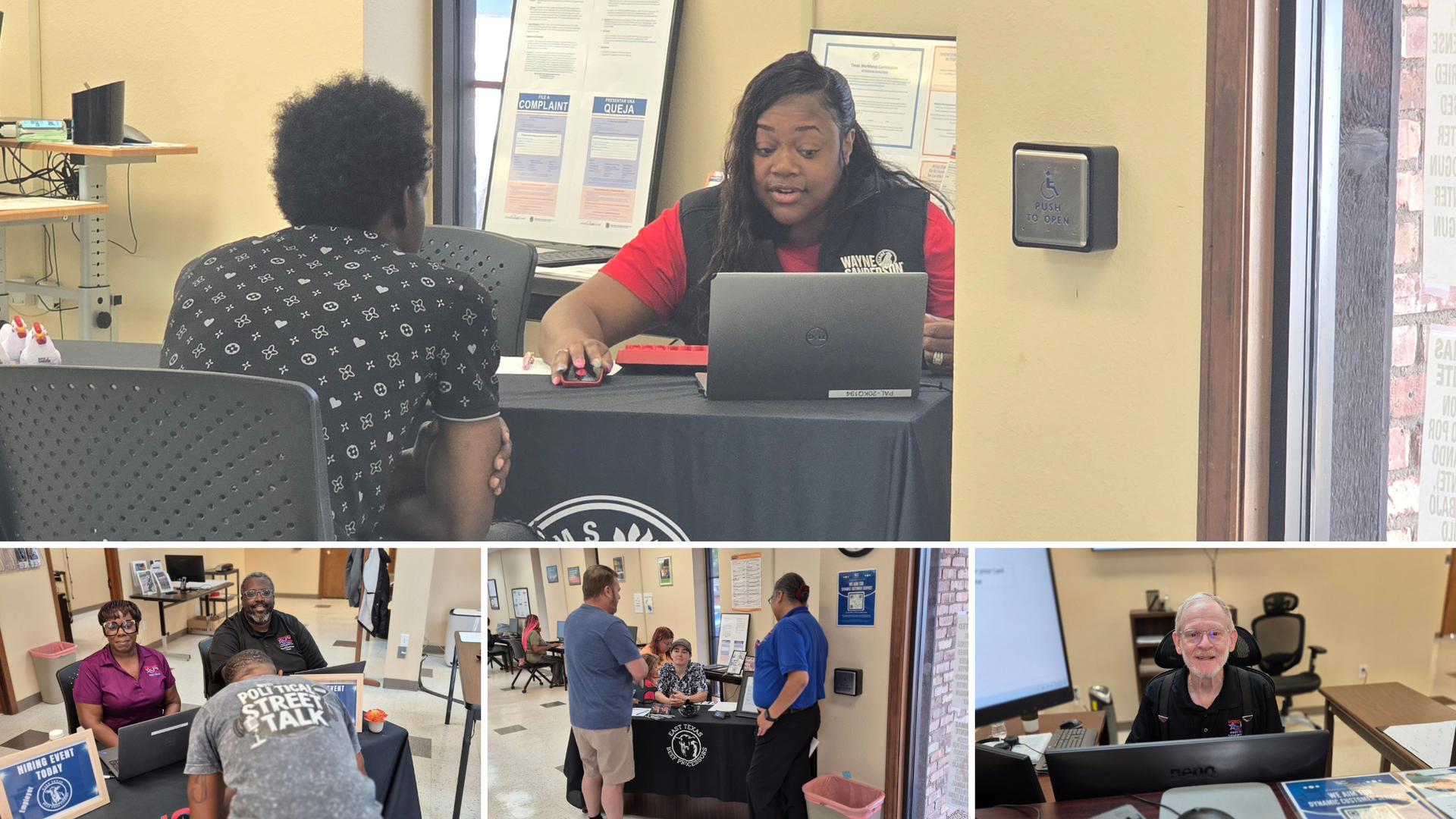
Workforce Solutions East Texas is strengthening its role as a workforce development leader in the Palestine area by bringing some of the region’s top employers directly to the community. Through a growing series of hiring events hosted at the Palestine office, local job seekers are gaining direct access to employers, career opportunities, and a dedicated team ready to help them take their next step. The events have already generated strong results. On August 14, Wayne Sanderson Farms brought 51 job seekers to the Palestine office for a hiring event. The response was so strong that the company was able to fill its entire first shift through the event, demonstrating the impact that direct connections between employers and job seekers can have. The momentum continued on September 4, when East Texas Beef Processors welcomed 50 job seekers to its hiring event at the Palestine office. The strong turnout provided the company with an opportunity to connect with local talent while giving residents a chance to learn more about available careers and employment opportunities. These events are doing more than filling positions. They are helping Workforce Solutions East Texas build stronger relationships with employers throughout the region while establishing the Palestine office as a convenient, trusted resource for businesses and job seekers alike. By creating opportunities for employers to recruit locally, Workforce Solutions East Texas is helping strengthen the connection between the region’s workforce and the businesses that drive its economy. Residents looking for their next career opportunity are encouraged to stop by the Palestine Workforce Solutions East Texas office, meet with employers, explore available positions, and connect with the staff who are ready to provide guidance and support throughout their job search. As the Palestine office continues expanding its employer partnerships and hiring event offerings, Workforce Solutions East Texas is demonstrating what workforce development looks like in action: bringing employers and job seekers together, responding to the needs of the local economy, and creating pathways to opportunity right here in the community.

After 30 years with the same employer, Ms. Paul never imagined she would have to start over. Her career with a staffing company had been built over three decades of experience in customer service and payroll. Then, without warning, she was laid off. “It was nerve-wracking. I’m a single mom of two. How are we going to survive?” After such a long career with one employer, Ms. Paul wasn't sure where to begin. The job market had changed, and she worried about finding a position that valued her experience while meeting her salary needs. That's when she discovered Workforce Solutions East Texas and the RESEA program. Ms. Paul initially knew very little about RESEA. Through the program, she discovered the resources available through WorkInTexas.com, including the Virtual Recruiter, Resume Builder, job search tools, career exploration resources, and WIOA opportunities. But the greatest impact came from the personalized support of her Career Navigator, Cheryl Jackson. Cheryl helped Ms. Paul update her resume, explore new career possibilities, prepare for interviews, and regain confidence in a job market she hadn't navigated in 30 years. “Cheryl gave me the confidence to job search and interview. Thirty years ago was so different from now, so her guidance was very helpful.” Through career exploration and mock interviews, Ms. Paul discovered opportunities she had never considered and gained the confidence to present her skills to employers. “She gave me the confidence and support I needed.” Today, Ms. Paul is working in payroll and invoicing for a staffing company and will soon take on additional responsibilities in fleet management. What began as an unexpected and frightening transition became a new chapter filled with possibility. RESEA didn't just connect Ms. Paul with resource, it helped her recognize that after 30 years of experience, she wasn't starting over. She was moving forward with confidence. Her advice to others facing an unexpected job loss is simple: “Use all of your resources. You never know where a job will come from, so use everything.”