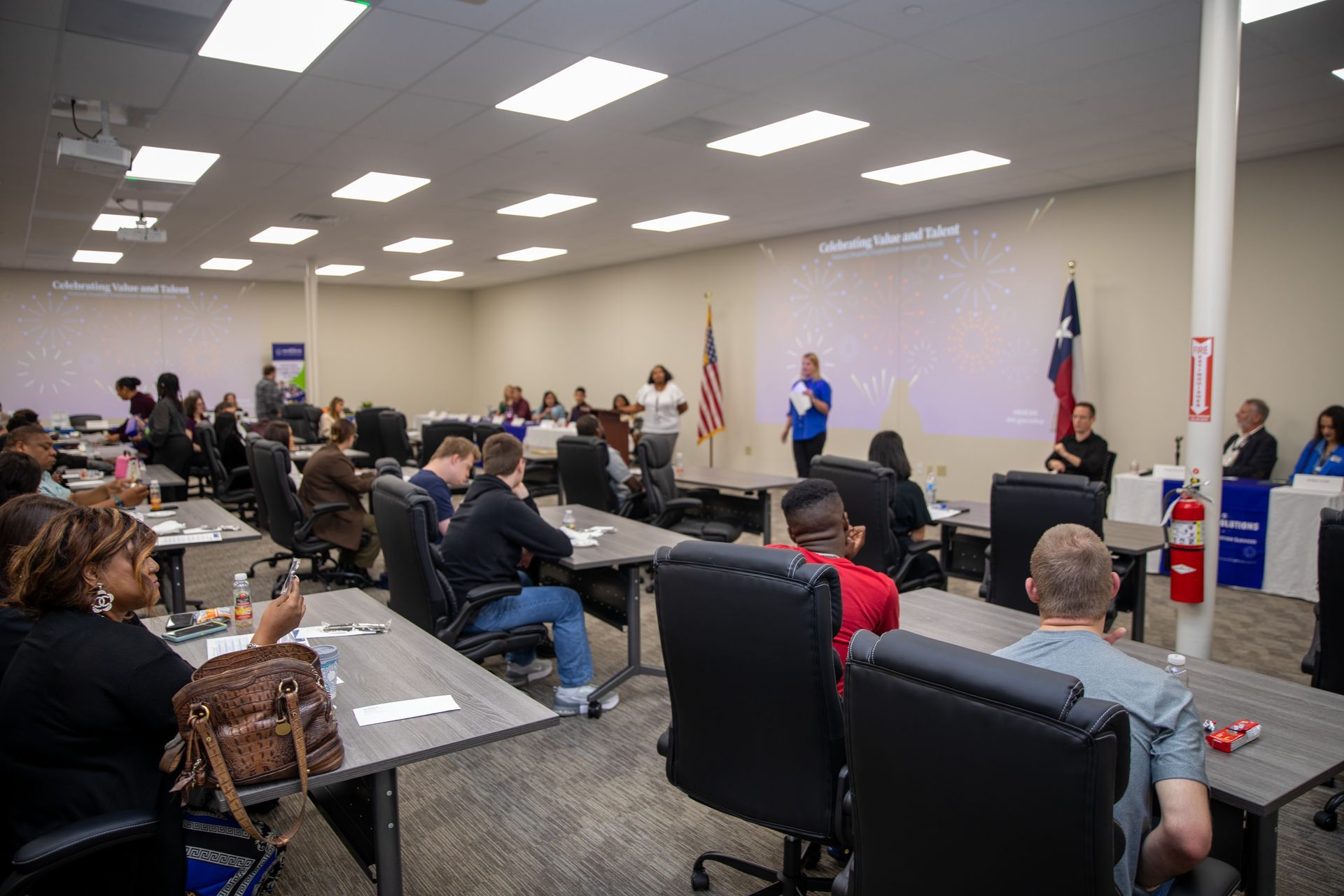
"Building Together. Winning Together. Career Fair 2024" Highlights Exciting Career Opportunities in Marshall and East Texas

Workforce Solutions East Texas • March 18, 2024

The Marshall Economic Development Corporation, in collaboration with the City of Marshall, Workforce Solutions East Texas, and the Texas Workforce Commission's Jobs Y'all program, recently hosted an extraordinary event that illuminated the pathways to success for students, parents, businesses, and educators alike. The "Spring Training: Building Together, Winning Together Career Fair 2024" went far beyond the traditional job fair format, transforming into a dynamic platform for career exploration and discovery.


Held under one roof, the career fair provided a comprehensive overview of the myriad career opportunities thriving in Marshall and across East Texas. With over 700 students, representatives from 50 local companies, and multiple colleges in attendance, the event was a resounding success, sparking enthusiasm and igniting aspirations.


This immersive experience offered students invaluable insights into potential career paths and tailored educational opportunities. Through interactive demonstrations and engaging discussions, attendees directly engaged with industry professionals, gaining firsthand knowledge of the skills and qualifications required for various professions.


Executive Director of Marshall Economic Development, Rush Harris, CEcD, was enthusiastic about the participation across sectors. “We saw students from five ISDs come to Marshall, Texas, to visit with all kinds of businesses and educators and learn what their future jobs might look like. It’s not just for the students, though. The event also lets businesses and educators communicate about skills training demand and supply. Additionally, it connects all parties to Workforce Solutions East Texas. We could not do events like this without their partnership!”


The presence of local businesses underscored the vibrant economic landscape of Marshall, shedding light on the diverse job opportunities available within the community.


The "Spring Training: Building Together, Winning Together Career Fair 2024" exemplified the power of collaboration and collective effort in shaping the future workforce. By bringing together students, parents, businesses, educators, and workforce professionals, the event fostered a sense of community and shared purpose, laying the foundation for a thriving and prosperous future for Marshall and the East Texas region.

January 30, 2026
Texas added 19,700 nonfarm jobs in December to reach a total of 14,341,000 positions. Over the year, the state added 132,500 jobs for an annual nonfarm growth rate of 0.9 percent, outpacing the national growth rate by half a percentage point. Texas’ civilian labor force registered at 15,964,000 after adding 25,000 people over the month. This marks a new record-high level for the series. Over the year, Texas’ civilian labor force has added 236,300 people. The seasonally adjusted unemployment rate in Texas registered at 4.3 percent. “Texas added more than 19,000 jobs in December, with growth spread across a majority of major industries,” said TWC Chairman Joe Esparza. “We are focused on ensuring Texas remains a national leader in economic opportunity through innovative, forward-looking initiatives like Skills for Small Business, the Texas Internship Network, and Texas Industry-Recognized Apprenticeships.” The Trade, Transportation, and Utilities industry had the largest private sector over-the-month increase in December after adding 9,500 jobs. Leisure and Hospitality added 3,700 jobs over the month while Professional and Business Services added 3,000. In addition, Private Education and Health Services posted an annual growth rate of 2.3 percent in December, which was the highest of any major industry. “Tens of thousands of people joined the Texas labor force last month,” said TWC Commissioner Representing Labor Alberto Treviño III. “To connect all segments of our growing labor force with employment opportunities, TWC offers a wide array of resources such as job fairs, labor market information, and vocational rehabilitation services to link Texans with meaningful careers.” The Amarillo metropolitan statistical area (MSA) had the lowest unemployment rate with a not seasonally adjusted rate of 2.8 percent in December. It was followed by the Midland and San Angelo MSAs, which both registered at 2.9 percent. “Every bit of great news and well-deserved accolades the Texas economy receives inspires our efforts,” said TWC Commissioner Representing the Public Brent Connett. “TWC will continue to help build a robust, well-trained workforce and a bigger, better, stronger economy for a more prosperous future for Texans.” Employment estimates released by TWC are produced in cooperation with the U.S. Department of Labor’s Bureau of Labor Statistics. * All estimates are subject to revision. To access this and more employment data, visit TexasLMI.com . 
January 20, 2026
When Latavia Harris unexpectedly lost her job, she found herself facing a moment of uncertainty. The disruption was more than financial—her plans for the future were suddenly placed on pause. Yet even in that difficult moment, Latavia chose resilience. She made the same decision thousands of East Texans make each year when navigating job loss: she applied for unemployment. That simple step became the bridge to something much bigger. Through the unemployment process, Latavia was connected to the RESEA (Reemployment Services and Eligibility Assessment) program at Workforce Solutions East Texas. RESEA provides structured guidance and support to job seekers receiving unemployment, equipping them with the tools to navigate the job search process and overcome barriers that may prevent them from returning to the workforce. In the program, staff helped Latavia refresh her resume, strengthen her interview skills, and explore new career pathways. As she gained encouragement and direction, she began to rebuild her job prospects. That journey led her somewhere she never expected—to a role within the very organization that had helped her rebuild. Today, Latavia serves as a Career Navigator for the WIOA Youth program at Workforce Solutions East Texas, joining the ranks of a team she once turned to for support. In her new role, Latavia feels a special connection with the young adults she serves. Having recently been in a similar position herself, she understands their fears, their doubts, and the courage it takes to begin again. This lived experience fuels her commitment to help them succeed, so they too can experience how Workforce programs can change a person’s future for the better. “All of the programs in Workforce do our community well,” Latavia shares. “It helps us be able to do the work and get back to work.” Latavia speaks openly about the difference her future coworkers made during her time as a participant. Their backing, encouragement, and support played a major role in helping her pursue a new and exciting career path—and find stability after a difficult season. Her transition into the workforce felt different this time, she explains: “One of the things I could tell was different in coming to Workforce from like ten years ago to when I had to come back this summer, was it was very open, very welcoming. You knew that they wanted to help you get back to work.” Being met with genuine care reshaped how she viewed workforce development—and her own goals. “It was like, wow— I want to be part of a team that is happy about what they are here doing, is happy to impact lives,” she reflects. “They wanted to genuinely help me and were happy to help me. So, I was like when I am back to work, this is the type of team I want to work with.” Latavia’s journey serves as a powerful reminder of the long-term impact of workforce development. Its value extends far beyond reemployment—it fosters confidence, builds futures, strengthens families, and contributes to the stability of communities across East Texas. What began as a setback became a calling. Latavia now helps others take their next steps forward, carrying with her a lived understanding that the right support at the right time can transform a moment of crisis into a story of resilience, renewal, and purpose.
January 13, 2026
Texas added 7,300 nonfarm jobs in November to reach a total of 14,321,000 positions. Over the year, the state added 146,300 jobs for an annual nonfarm growth rate of 1.0 percent, outpacing the national growth rate by 0.4 percentage points. Texas’ civilian labor force registered at 15,938,500 after adding 59,500 people since September 2025 and reaching a new record high level for the series. Over the year, Texas’ civilian labor force has added 206,800 people. The seasonally adjusted unemployment rate in Texas registered at 4.2 percent. “As Texas employers add thousands of jobs, TWC programs can help them grow, develop, and retain a skilled workforce,” said TWC Chairman Joe Esparza. “Initiatives like Skills for Small Business and the Skills Development Fund are training Texans for in-demand jobs that will cement Texas’ reputation as the best state in the nation for doing business.” The Private Education and Health Services industry had the largest private sector over-the-month increase in November after adding 5,700 jobs. Professional and Business Services added 3,900 jobs over the month while Manufacturing added 2,300. In addition, the Construction industry posted an annual growth rate of 2.8 percent in November, which was the highest of any major industry. “Texas' increasing job numbers are encouraging, and it's vital that these are good jobs that provide family-sustaining wages and benefits for Texas workers. We must continue to prioritize investments in skills training and development to ensure that all Texans can access these opportunities and share in the state's prosperity,” said TWC Commissioner Representing Labor Alberto Treviño III. “As we celebrate this growth, let's also remain committed to fair labor practices and worker protections to ensure a thriving workforce for years to come.” The Amarillo metropolitan statistical area (MSA) had the lowest unemployment rate with a not seasonally adjusted rate of 3.1 percent in November, followed by the Midland MSA at 3.2 percent. The College Station-Bryan and San Angelo MSAs both registered at 3.3 percent. “Texas’ job growth in November not only highlights the benefits of our diverse and growing economy but also underscores the importance of making sure Texans can thrive in their communities,” said TWC Commissioner Representing the Public Brent Connett. “TWC and our statewide network of local partners are able to continue strengthening the Texas economy and the foundations of our communities.” Employment estimates released by TWC are produced in cooperation with the U.S. Department of Labor’s Bureau of Labor Statistics. *All estimates are subject to revision. To access this and more employment data, visit TexasLMI.com.
Show More